"One thing that differentiates knowledge work today from other craft work is that, except for final product, knowledge work is essentially invisible. All the important stuff takes place inside knowledge workers's heads. This has not always been true of knowledge work and need not be true.
. . One unintended consequence of today's technology environment is to make the process of knowledge work less visible just when we need it to be more so. The end products of knowledge work are already highly refined abstractions; a financial analysis, project plan, consulting report, or article. Today, the evolution from germ of an idea through intermediate representations and false starts to finished product exists, if at all, as a series of morphing digital representations and ephemeral feedback interactions."
"In the pre-industrial era, education and work were: Observable, connected
In the post-industrial era, they are: Non-observable, disconnected"
Jim McGee 18:14
I had an insight many years ago when I was trying to understand why it was that we weren't seeing take up of the system, the knowledge management systems we were deploying. What was, why weren't we getting knowledge sharing? Why wasn't it happening? And what I realized in the shower one morning, where all best ideas occur, I got it. I knew who the lazy SOB was, wasn't doing the share. It was me six months ago.Jim McGee 18:49
I wasn't sharing with myself. I wasn't paying attention to what I needed to do when I did it. And so I couldn't I couldn't find my own work. And I can't find In my own work and on the other knowledge workers in your organization can't find their own work.Jim McGee 19:27
And the sharing takes places, the sharing if you look at the social dimension of knowledge sharing in most organizations, it all starts with a conversation or a phone call. You never find anything useful going directly into the knowledge management system. Never. You always find something useful talking to someone who will point you to - and we keep thinking of that as a bug, not a feature.Jim McGee 19:59
But that's really the only way it's going to work.
Jim McGee 31:13
So if you get if you get too focused on deliverables you lose sight of what sort of what comes after the deliverable, which is the decision or the action. So, but you start with deliverables and you start making you start tracking and you keep you pay attention.Jim McGee 31:28
But the next piece is then you move back to a concept that I learned back in my days when I had to work in an auditing firm. I was a consultant, but it was it was Arthur Andersen and they wanted all of us to pretend that we knew something about auditing. I actually had to go into a vault once and literally count stock certificates and bond certificates as part of an audit.Jim McGee 32:05
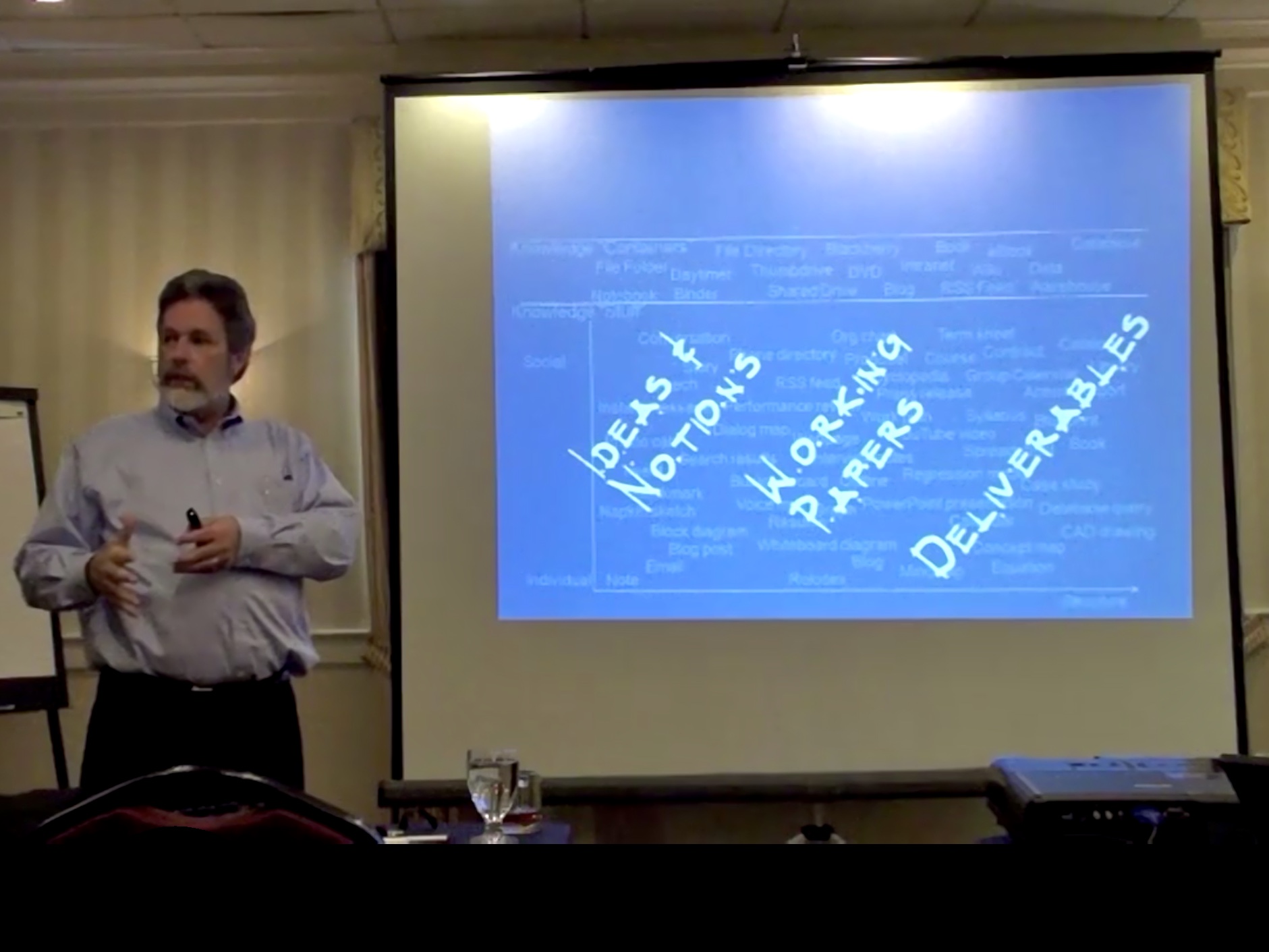
But one of the brilliant things that auditors did is they created this notion of working papers. They were all paper that but you know all of the documents and memos in the in the intermediate products that they worked with along the way to get to the.. . Cause the deliverable for an auditor was it was a two page letter. Right? Jim McGee 32:27
And in fact, 90% of that two page letter was strict boilerplate. So what they needed to do in order to justify it to themselves and to their clients, but they needed to, they needed to be able to demonstrate what work had gone into creating a deliverable. We reviewed this many accounts, we sent these letters out to, you know, shareholders, we did X we did Y we ran this analysis, we found that and so this notion of working papers is a useful one to recover and to think in terms of as you do the work work you're doing is to think in terms of the intermediate products because the intermediate products are the ones where real reuse is going to be possible.. . Jim McGee 33:42
Okay, now I got to source the data differently, but the analytic piece still holds. Now if it's buried in a deliverable I can't I can't find it. So you know, I can I you know, what, what you'll do if you're if your knowledge system is only working with deliverables is you go in, you open up a bunch of deliverables and you skim through it, you look for the graph, and then you try, then you hope you can find the particular analyst who did the work.Jim McGee 34:10
Because, you know, damn well the partner doesn't understand what went into the analysis and track that individual down and say, you know, Mary, what, how was it that you did that? Right? And what was the creative? So, you know, I think the next piece of this, you know, to attack is going after work again, creating those intermediate objects and making those visible with tags, nothing, nothing exotic.
Jim McGee 34:39
You just, you want to be able to find them when you need them. And give a little bit of thought to that. And eventually, you know, I think we're gonna get back to capturing scraps of ideas and notions and whatnot. I saw over there. I Oh, and I always have paper on, you know, little notebook in my pocket, just because you I'm old enough, if I don't capture it, if that idea comes, it's going in a hurry. If I don't get it as it goes by, it's never coming back.Jim McGee 35:15
And so you do those and then and then the other thing that I've learned with you that you then have to write it down a second time. If to take a little note and you have to read the note and reconstruct what you were thinking when you wrote the note. Right? And if you do that within 24 hours that usually works. If you wait 48 hours, it's -- I can't actually I can't read my handwriting after about 72 hours.
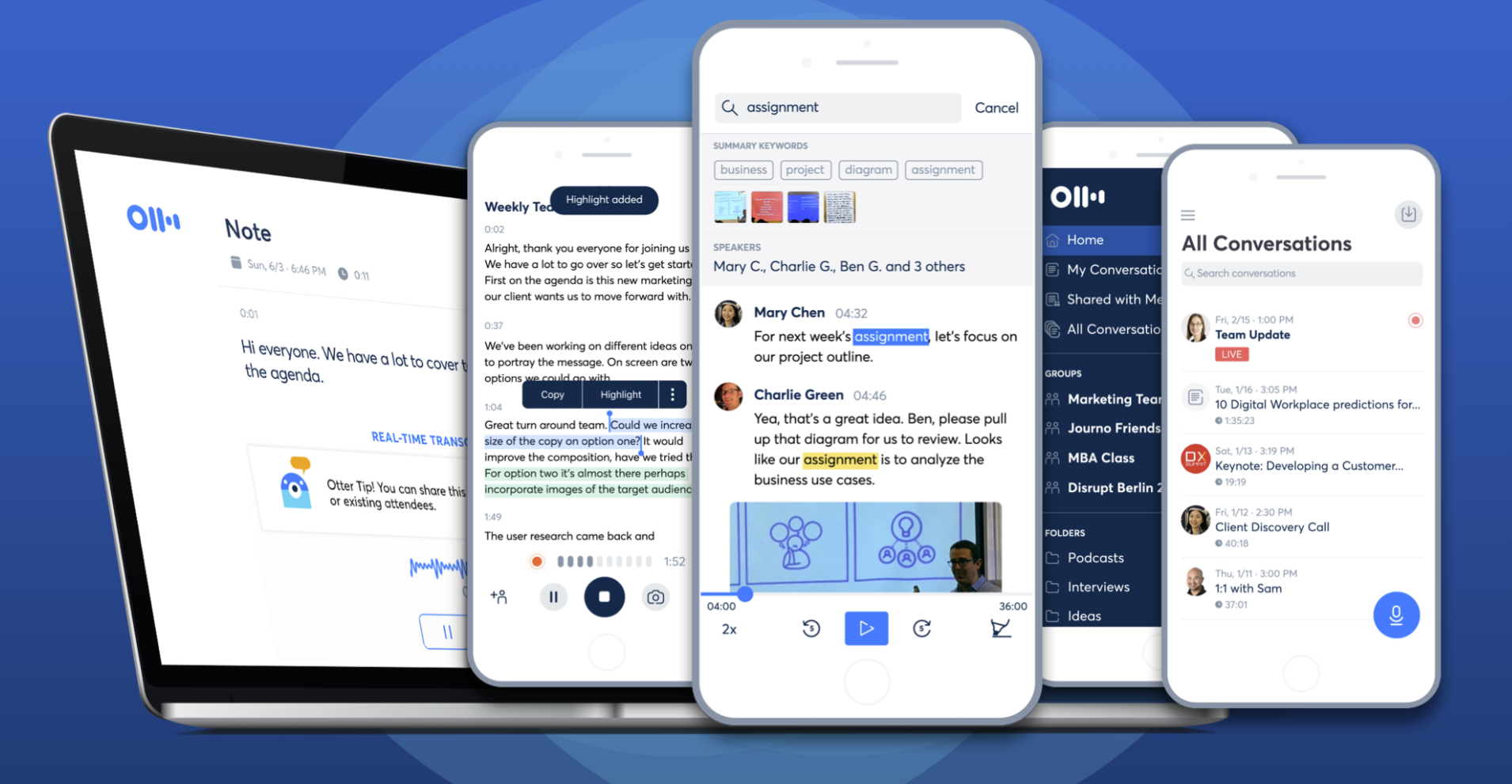
Otter is a cloud-based speech to text program especially aimed for mobile use, such as on a laptop or smartphone. The app provides real-time transcription, allowing you to search, edit, play, and organize as required.
Otter is marketed as an app specifically for meetings, interviews, and lectures, to make it easier to take rich notes. However, it is also built to work with collaboration between teams, and different speakers are assigned different speaker IDs to make it easier to understand transcriptions.
There are three different payment plans, with the basic one being free to use and aside from the features mentioned above also includes keyword summaries and a wordcloud to make it easier to find specific topic mentions. You can also organize and share, import audio and video for transcription, and provides 600 minutes of free service. [per month]
The Premium plan comes in at $8.
33 per month when paid annually, and on top of existing features also includes advanced and bulk export options, the ability to sync audio from Dropbox, additional playback speeds including the ability to skip silent pauses. The Premium plan also allows for up to 6,000 minutes of speech to text. [per month] The Teams plan comes in at $12.
50 per user for a minimum of three users, and also adds two-factor authentication, user management and centralized billing, as well as user statistics, voiceprints, and live captioning.
fullsizeoutput_1965b.jpeg
fullsizeoutput_1961f.jpeg
Otter product photo 27Jul2020.png
TUG 2010 Keynote Jim McGee.txt