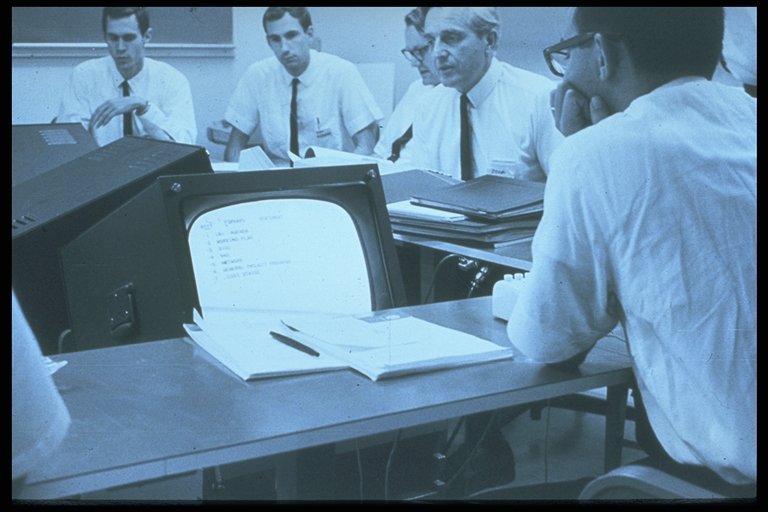
The source of the term Journal for the Traction TeamPage database is Douglas Engelbart's NLS system (later renamed Augment), which Doug and his SRI team developed in the 1960's as one of the first two working hypertext systems. Traction's time ordered and journaled database, entry + item ID addressing, and many Traction concepts were directly inspired by Doug's work. The major use cases for Traction TeamPage follow Doug's CODIAK model for collaborative, dynamic, continuous work, see CODIAK Model, below.
Doug and his team created NLS/Augment (including the Journal, along with the mouse, shared-screen interactive hypertext and video, dynamic outlining, and many other inventions) to support the needs of high performance, problem solving teams. He refers to his top level goal as augmenting human intellect:
By "augmenting human intellect" we mean increasing the capability of a man to approach a complex problem situation, to gain comprehension to suit his particular needs, and to derive solutions to problems. Increased capability in this respect is taken to mean a mixture of the following: more-rapid comprehension, better comprehension, the possibility of gaining a useful degree of comprehension in a situation that previously was too complex, speedier solutions, better solutions, and the possibility of finding solutions to problems that before seemed insoluble. And by "complex situations" we include the professional problems of diplomats, executives, social scientists, life scientists, physical scientists, attorneys, designers--whether the problem situation exists for twenty minutes or twenty years. We do not speak of isolated clever tricks that help in particular situations. We refer to a way of life in an integrated domain where hunches, cut-and-try, intangibles, and the human "feel for a situation" usefully co-exist with powerful concepts, streamlined terminology and notation, sophisticated methods, and high-powered electronic aids. 1a1
Doug’s first NLS/Augment systems were deployed in the late 1960'a as part of the original ARPANet Network Information Center (NIC), starting with ARPANet Node 3 at SRI - i.e. the third node on what we know as the Internet. I'd also claim that Doug's Journal is the first blog - dating from 1969.
I’ve known and admired Doug’s work starting as an undergraduate Computer Science student using Andy van Dam and Ted Nelson's first hypertext system at Brown (1969). I had the privilege of meeting and working with Doug in the late 1980’s when he and Andy became members of Context Corporation's technical advisory board (Context was a commercial hypertext editing and publishing system with built in change tracking and early SGML support, used for aircraft maintenance manuals and similar applications).
Doug and Andy would visit Context in Portland OR every quarter for a three day meeting - on Context's plans, their advice, and their perspective on hypertext history and evolution. We also enjoyed meals and conversation. I'll always remember Doug's quiet and smiling manner as well as his incredible determination, deep understanding, moral commitment, and pioneering vision. He was and remains a hero to me.
My advice - if you want to invent the future of the web and social software, carefully read what Doug, Andy, Ted and Alan Kay have written. Their wikipedia bio's are a good starting point - I'll post a few favorite quotes here.
In 1975 Doug wrote: Our Journal system was conceived by this author in about 1966. I wanted an underlying operational process, for use by individuals and groups, that would help bring order into the time stream of the Augmented Knowledge workers. The term "journal" emerged early in the conceptualization process for two reasons:
I felt it important in many dynamic operations to keep a log (sometimes termed a "journal") that chronicles events by means of a series of unchangeable entries (for instance, to log significant events while evolving a Plan, shaping up a project, trouble-shooting a large operation. or monitoring on-going operations). These entries would be preserved in original form, serving as the grist for later integration into more organized treatments.
I also wanted something that would serve essentially the same recorded-dialogue purpose as I perceived a professional journal (plus library) to do.
Compcon 75 Digest, Sep 1975 pp 173-178, Douglas C. Engelbart THE NLS JOURNAL SYSTEM see the full paper, courtesy of the Doug Engelbart Institute.
Doug Engelbart's CODIAK model - Collaborative, Dynamic, Continuous work
A result of this continuous knowledge process is a dynamically evolving knowledge base as shown in Figure-7 below, consisting of three primary knowledge domains: intelligence, dialog records, and knowledge products (in this example, the design and support documents for a complex product).
Intelligence Collection: An alert project group, whether classified as an A, B, or C Activity, always keeps a watchful eye on its external environment, actively surveying, ingesting, and interacting with it. The resulting intelligence is integrated with other project knowledge on an ongoing basis to identify problems, needs, and opportunities which might require attention or action.
Dialog Records: Responding effectively to needs and opportunities involves a high degree of coordination and dialog within and across project groups. This dialog, along with resulting decisions, is integrated with other project knowledge on a continuing basis.
Knowledge Product: The resulting plans provide a comprehensive picture of the project at hand, including proposals, specifications, descriptions, work breakdown structures, milestones, time lines, staffing, facility requirements, budgets, and so on. These documents, which are iteratively and collaboratively developed, represent the knowledge products of the project team, and constitute both the current project status and a roadmap for implementation and deployment. The CODIAK process is rarely a one-shot effort. Lessons learned, as well as intelligence and dialog, must be constantly analyzed, digested, and integrated into the knowledge products throughout the life cycle of the project.
Figure-7:: The CODIAK process -- collaborative, dynamic, continuous.
Figure 7 itemizes the evolving knowledge base within three categories: (1) Dialog Records: memos, status reports, meeting minutes, decision trails, design rationale, change requests, commentary, lessons learned, (2) External Intelligence: articles, books, reports, papers, conference proceedings, brochures, market surveys, industry trends, competition, supplier information, customer information, emerging technologies, new techniques (3) Knowledge Products: proposals, plans, budgets, legal contracts, milestones, time lines, design specs, product descriptions, test plans and results, open issues.
from 'Toward High-Performance Organizations: A Strategic Role for Groupware' Douglas C. Engelbart, Bootstrap Institute, June 1992 (AUGMENT,132811) see the full paper, courtesy of the Doug Engelbart Foundation
[ quoted from grl1427, Greg Lloyd's private TSI blog post of August 2002 ]
Article: Blog50 (permalink) Categories: :Public:whitepaper, :Blog:thoughtvectors, :Blog:TractionHistory, :Blog:key, :Blog:quotes Date: April 9, 2006; 11:25:22 AM Eastern Standard Time